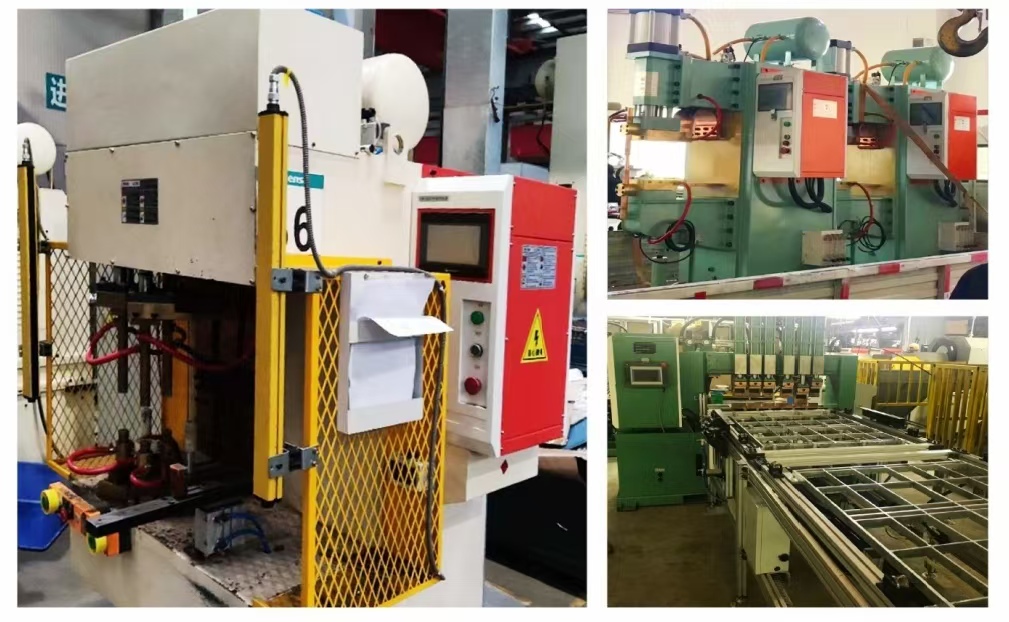


Essential details
Quantity(pieces):1000
G.W:30 kg
Size:L(600)*W(500)*H(300) cm
N.W:25 kg
Shipping:Land transport, Sea transport
Specification Number:IAW-1400T
Product Code:IAW-1400T
Package Description:Wooden case packaging
Product Introduction
Advantages of Medium Frequency Inverter Resistance Welding Machine:
Comparison with Conventional Line-Frequency AC Welding Machines
| Category | Conventional Line-Frequency AC Welding Machine | Medium-Frequency Inverter DC Controller |
|---|---|---|
| Performance | Conventional line-frequency AC welding machines adjust the secondary output of the welding transformer by changing the thyristor firing angle. Since the transformer is directly connected to the grid via thyristors, the power factor is low. The adjustment cycle of line-frequency controllers is long (20 ms for 50/60 Hz grids). | The medium-frequency inverter DC controller converts three-phase AC to DC, then outputs to the welding transformer via IGBT inversion. With a high power factor, its inverter frequency is 1 kHz, and adjustment time is as short as 1 ms – 20 times faster than conventional controllers. It offers higher control accuracy, faster response, and more stable output. |
| Power Grid | The input voltage is single-phase 380V, causing two phases to draw high current and one phase to draw zero current. This unbalances the three-phase grid, leading to low grid utilization, high reactive power, and significant grid pollution. Multiple machines require large-capacity transformers, increasing customer costs. | The input voltage is three-phase 380V, with balanced three-phase current and very high grid utilization. Using three-phase full-wave rectification, the power factor reaches over 90%. |
| Power Control | Conventional controllers adjust welding current via thyristor firing angle. Current zero-crossing causes blank heating, poor heat concentration, and unstable welding quality. Long zero-crossing times worsen effects. Large grid voltage fluctuations cause current swings, severely impacting stability. Secondary circuit inductance also significantly affects welding current. | The welding current is DC, with no zero-crossing. Heat is highly concentrated, heat loss is low, and welding time is shortened, resulting in significant energy savings. No AC peak values, so it is unaffected by grid fluctuations, reducing spatter and extending electrode life. Secondary circuit inductance has almost no effect on welding current, eliminating secondary loop losses. |
| Transformer | Equipped with transformers operating at 50/60 Hz. At the same power rating, line-frequency transformers are large, bulky, lossy, and low-efficiency. | Equipped with medium-frequency transformers operating at 1 kHz. At the same power rating, they are much smaller, with low losses, high efficiency, and easier installation. |
In addition to the above advantages, medium-frequency inverter welding machines offer many more benefits, including a wide range of welding conditions, compatibility with various materials (medium-frequency machines can weld coated steels, galvanized steels, stainless steel, aluminum, and dissimilar metals), and combined welding characteristics, leading to widespread use in the industry.
1.Controller Features
- Output power frequency: 15-400HZ, time precision at ms level
- Programmable up to 32 sets of welding specifications
- Three-stage heating process: preheating, welding, tempering; the welding stage allows custom ramp-up/ramp-down and cycle counts
- Programmable output I/O ports: 3-stage programmable output for better compatibility with PLC, robots, etc.
- Communication and BCD code control: connectable to industrial PC, PLC, etc., for remote control and automated management
- Secondary coil feeds back welding current in real time for closed-loop control, ensuring precise current control
- Alarm recording function for easy access to historical alarm information
- Current control accuracy: 5‰
2. Basic Controller Parameters
- IAW Series Medium Frequency AC Resistance Welding Controller
Inverter Mode Medium Frequency AC Model IAW-300L IAW-400T IAW-600T IAW-800T IAW-900T IAW-1400T IAW-1800T IAW-2800 Input Voltage(V) Three-phase 380V, voltage fluctuation +10%, -20%; frequency 50HZ/60HZ±1% Max Output Current(A) 350A 500A 600A 900A 1000A 1600A 2000A 3000A Matching Transformer 80KVA 100KVA 120KVA 180KVA 200KVA 250KVA 300KVA 350*2KVA Secondary No-Load Voltage 11.25V 11.25V 11.25V 11.25V 13.5V 13.5V 13.5V 13.5V Air Switch Capacity 100A 125A 125A 160A 160A 200A 200A 400A Current Setting Range 0-350A/0-20KA 0-500A/0-25KA 0-600A/0-30KA 0-900A/0-40KA 0-1000A/0-45KA 0-1500A/0-50KA 0-1600A/0-60KA 0-3000A/0-70KA Control Method Constant Current / Constant Conduction Angle Number of Air Valves Standard models are equipped with 4 air valves, while seam welding machines are equipped with 10 air valves. Inverter Frequency 15-400 HZ Solenoid Valve Rated Output Voltage(V) DC24V±10% Solenoid Valve Rated Output Current(A) ≤0.15A per channel Communication Mode Rs485 Maximum Welding Specification 32 groups, expandable to 256 groups Cooling Water Requirement 6L/min,≥0.15Mpa, temperature ≤40℃ 8L/min,≥0.15Mpa, temperature ≤40℃ 12L/min,≥0.15Mpa, temperature ≤40℃ Operating Temperature(℃) Water cooling -5℃~50℃ Ambient Humidity (%) ≤80% Operating Altitude (Km) 1 Insulation Class Class F Housing Dimensions(mm) Standard (customizable on request) - Operating Parameters
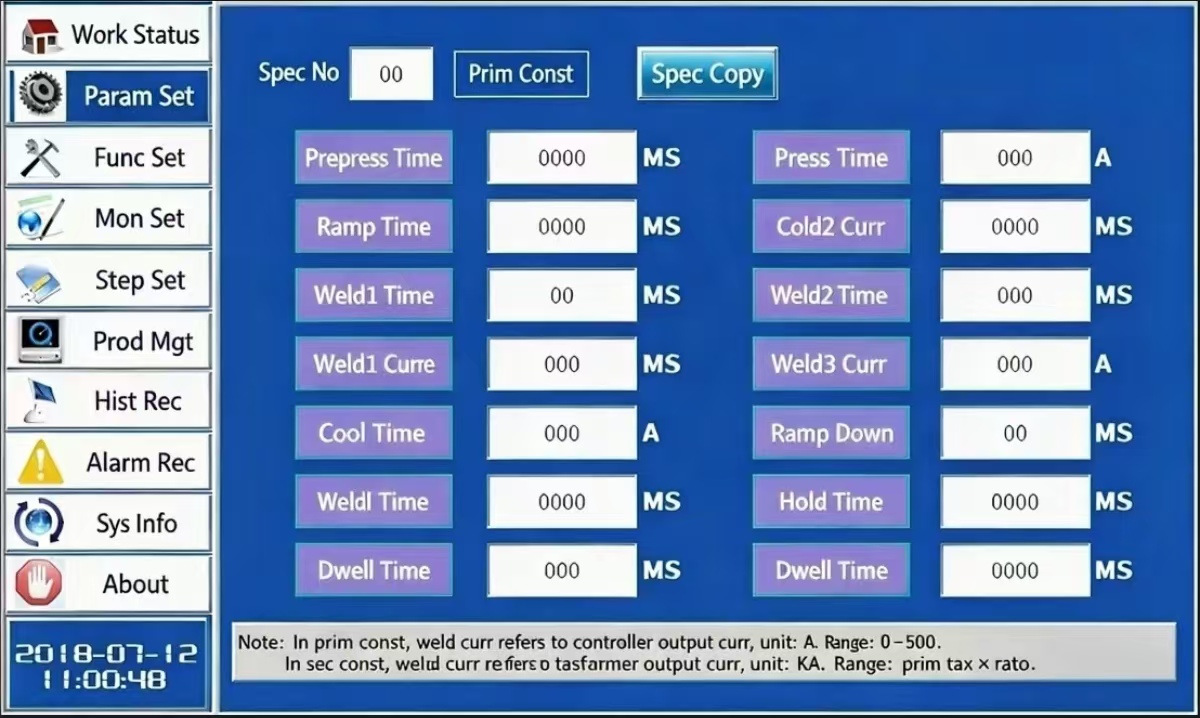
Parameter Description / Value Start Signal Start Switch 1, Start Switch 2 Solenoid Valve Drive 3 Groups Welding Program Storage 32 Sets Pre-pressure Time (ms) 0-9999 Pressure Time (ms) 0-9999 Ramp-up Time (ms) 0-99 Preheat Time (ms) 0-999 Cooling Time (ms) 0-9999 Welding Time (ms) 0-999 Cooling Time (ms) 0-9999 Temper Time (ms) 0-999 Ramp-down Time (ms) 0-99 Hold Time (ms) 0-9999 Idle Time (ms) 0-9999 Current Control Current 1 CC1 (Primary Constant Current) Primary Current 0-9999 (Unit: A) CC2 (Secondary Constant Current) Secondary Current 0-99.99 (Unit: KA) Current 2 CC1 (Primary Constant Current) Primary Current 0-9999 (Unit: A) CC2 (Secondary Constant Current) Secondary Current 0-99.99 (Unit: KA) Current 3 CC1 (Primary Constant Current) Primary Current 0-9999 (Unit: A) CC2 (Secondary Constant Current) Secondary Current 0-99.99 (Unit: KA)
3.Controller Panel Description
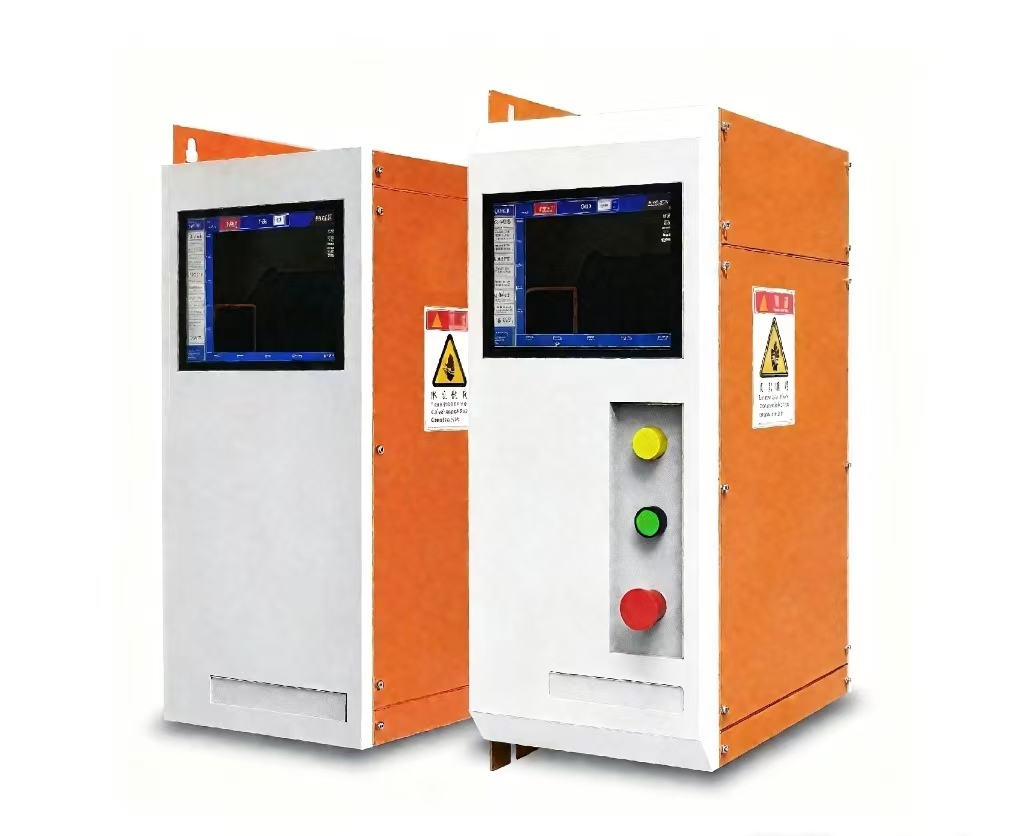
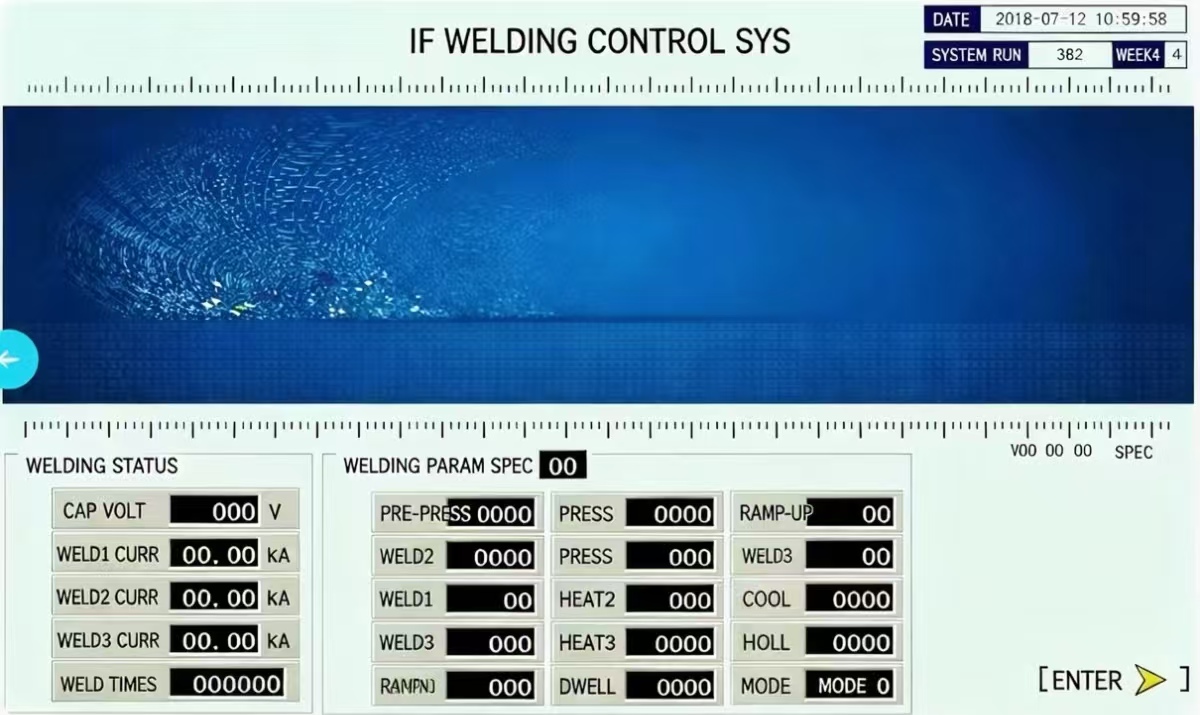
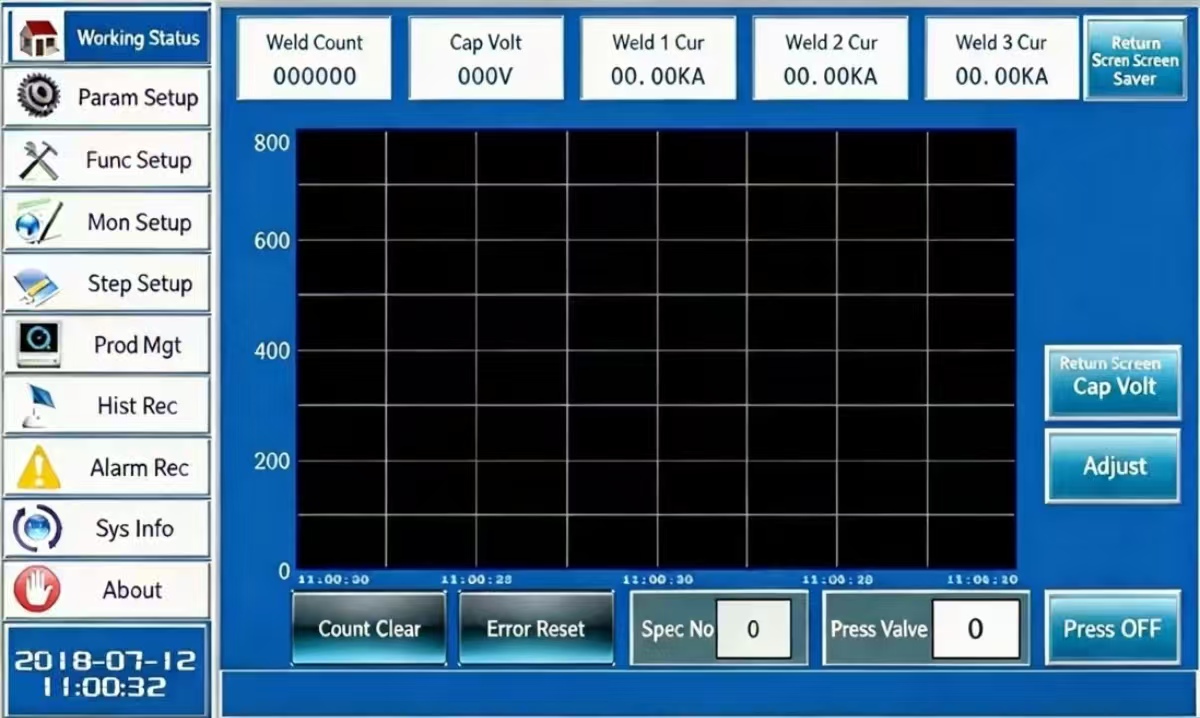
- 7-inch industrial touch screen for parameter setting and function selection, real-time monitoring of welding current, capacitor voltage, etc. All operations can be completed on the touch screen.

4.Controller Operation Instructions
- Display Introduction:After power-on, it automatically enters the Working Status screen; welding can only be performed in this screen.

- Parameter setting screen: for welding parameter configuration

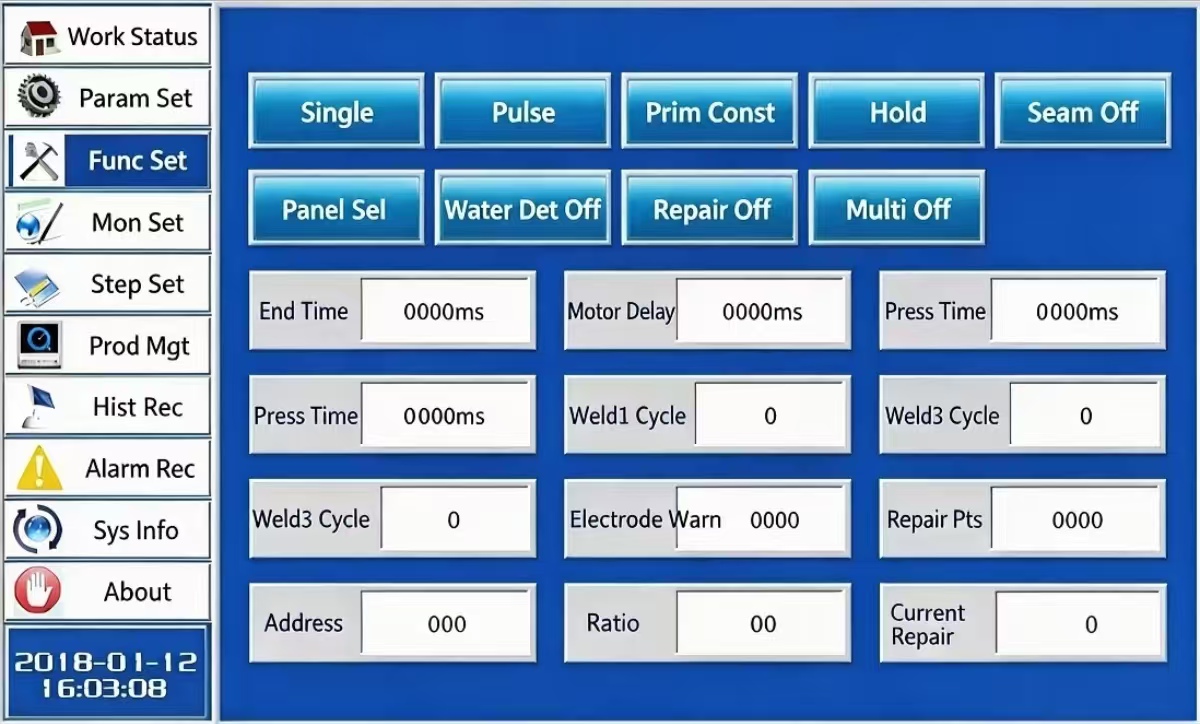
- Function setting screen: single/continuous, seam welding, primary/secondary constant current, water flow/temp detection, dressing, cycle welding, etc.

